Early Years has its own pedagogy, identity and understanding of how young children learn. It should not be treated simply as an add-on to Primary, or as a phase where children are ‘just playing’ before the ‘real’ learning begins. However, protecting that distinctiveness should not mean leaving Early Years to operate on the edge of the wider school.
This balance is not always easy to achieve, particularly within a through-school. Early Years needs the freedom to work in developmentally appropriate ways, while the needs of its children are given equal consideration in leadership, safeguarding, improvement planning and whole-school decision-making.
What makes Early Years distinctive?
Effective Early Years practice brings together child-led and adult-guided learning. Teachers observe closely, respond in the moment and adapt experiences according to children’s individual development. The learning environment, daily routines and relationships are all part of the curriculum.
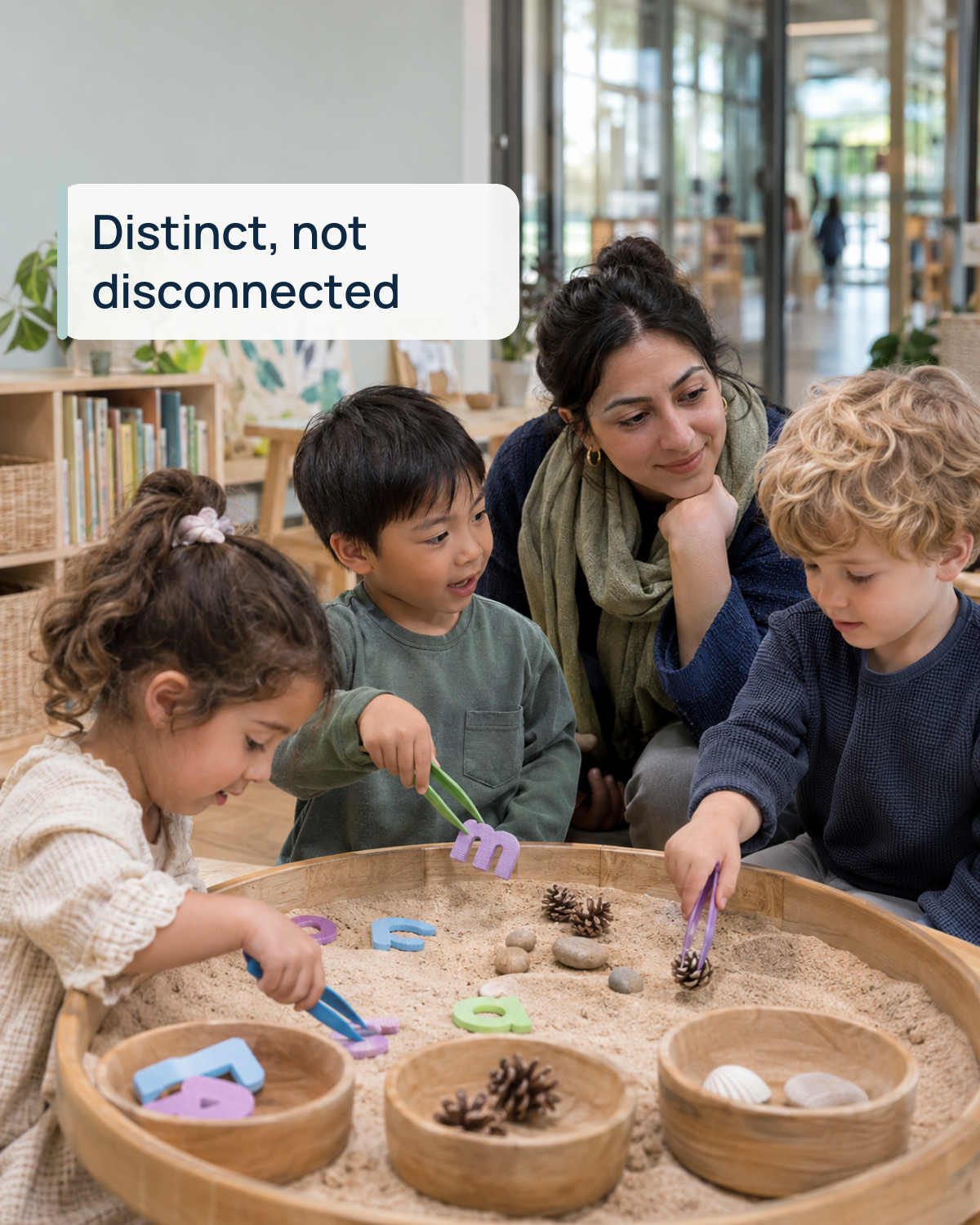
An activity that appears simple from the outside may be supporting several areas of learning at once. For example, children searching for foam letters in sand using tweezers might be developing their phonics knowledge, fine-motor control, communication, mathematical language and understanding of the world. Taking turns and sharing resources also supports personal, social and emotional development, while using the letters to print with paint adds a creative dimension.
The activity is not valuable simply because several areas of learning can be incorporated into it. Its value lies in how a skilled teacher observes what individual children are doing, engages with their thinking and decides how best to support their learning and development, including when to question, model, extend or step back.
This professional work can be easy to underestimate because it does not always resemble teaching in an older classroom. In reality, good Early Years teachers are continually noticing, assessing and responding, even during snack time, conversations, routines and apparently unstructured play.
Distinct practice is not less rigorous practice.
When distinct becomes disconnected
Although Early Years needs a strong identity, problems arise when it is treated as a separate unit that the rest of the school does not fully understand.
In a busy through-school, whole-school decisions can understandably be shaped by the systems and routines most familiar across Primary and Secondary. The implications for younger children may not always be immediately apparent, meaning that a policy, timetable, initiative or event needs thoughtful adaptation for Early Years. This is not usually a question of commitment to the phase, but may reflect different professional backgrounds and the many priorities leaders are balancing.
The consequences are not only organisational. Children experience them directly.
Transition into Year 1 can become unnecessarily abrupt if there is little shared understanding between phases. The structure of the day, balance between child-led and adult-led learning, expectations for independence, approach to behaviour and use of the environment may all change at once.
Preparation for Primary should not mean gradually making Reception less like Early Years. It should include Primary colleagues understanding what has supported children’s learning so far and considering how appropriate elements can continue.
Consistency does not have to mean uniformity
Some aspects of school life should be consistent across every phase. Values, safeguarding culture, inclusion, ambition and expectations of quality should not depend on a child’s age or which part of the school they attend.
Their implementation, however, should reflect children’s developmental needs.
Safeguarding provides a clear example. The same culture of vigilance, professional curiosity and appropriate action should extend across the whole school. However, the ways in which adults listen to young children, notice changes in behaviour and help them communicate concerns will look different from the systems used with older pupils.
The same principle applies to quality assurance, behaviour, assessment, timetabling and enrichment. A shared purpose does not always require an identical process. Whole-school expectations can remain consistent while their implementation reflects the age and developmental needs of the children.
Connection should work both ways
Meaningful connection is not only about helping Early Years fit into the wider school. The wider school should also be willing to learn from Early Years.
Observation, responsive teaching, meaningful child voice and learning across traditional subject boundaries all have relevance beyond the phase. So does the understanding that children’s learning, wellbeing and development cannot always be separated neatly.
Strategic discussions need to give equal weight to the likely impact of proposals on children in every phase. For Early Years, this means considering decisions through an understanding of how young children learn and develop. This helps leaders distinguish between expectations that should remain consistent across the school and those that require developmentally appropriate adaptation.
Useful questions for whole-school leaders include:
How has the likely impact on Early Years children been considered in this decision?
Which policies and systems need age-appropriate implementation in Early Years?
How well do leaders understand what effective Early Years teaching and learning look like?
Are Early Years priorities visible within whole-school improvement planning?
What could Primary and Secondary colleagues learn from Early Years practice?
Does transition build on children’s previous experiences, or simply prepare them for a sudden change?
Looking beyond the Early Years classroom
When I support schools through Early Years Set-Up & Start-Up Support, an Early Years Quality & Improvement Review or Early Years Leadership Advisory Support, I look beyond what happens within the classroom.
The quality of Early Years provision is also influenced by leadership structures, whole-school priorities, safeguarding culture, staffing decisions, professional learning and the extent to which the phase is understood by those making strategic decisions.
A strong Early Years phase needs its own identity and developmentally appropriate practice, alongside influence and meaningful connection with the wider organisation. When its distinctiveness is understood and the needs of its children are given equal weight, children experience greater continuity, leaders make better-informed decisions and effective practice can strengthen the whole school.
If your school is establishing, reviewing or strengthening its Early Years provision, you are welcome to get in touch.
