What sits beneath high-quality Early Years provision?
In schools and nurseries, it is often the things people do not immediately see that have the greatest impact on quality.
When we think about high-quality Early Years provision, our attention can often go first to the visible elements: the learning environment, the resources, the curriculum and the interactions taking place within the classroom. These are all important, but they are only part of the picture.
What happens in the classroom is shaped by a much wider set of decisions, expectations and systems operating behind the scenes.
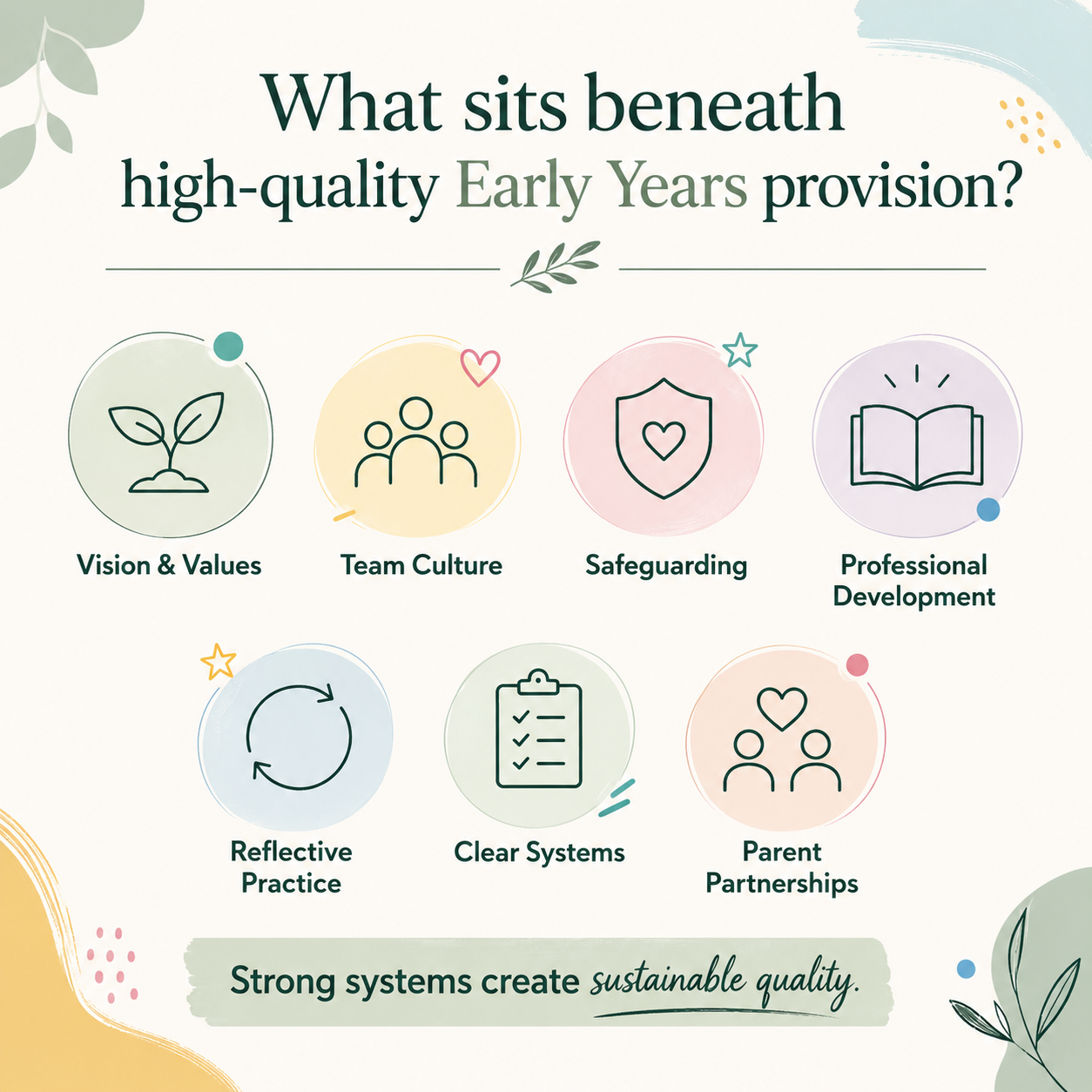
A shared vision
Strong provision begins with a clear understanding of what the setting is trying to achieve for its children and families.
A vision only becomes meaningful when it informs everyday decisions. Leaders and practitioners should have a shared understanding of what high-quality practice looks like in their setting, why particular approaches have been chosen and how those principles should be reflected across the provision.
Without that shared direction, even experienced practitioners may interpret expectations differently. This can lead to inconsistency between classrooms, teams or different parts of the day.
Team culture and professional learning
Good systems do not replace great people. They enable great people to do their best work consistently.
Practitioners need opportunities to discuss their work, reflect honestly and develop their practice over time. A single training session may introduce useful knowledge or begin an important conversation, but meaningful professional development continues through coaching, feedback, observation and ongoing professional discussion.
The culture surrounding that learning matters too. Staff need to feel able to ask questions, acknowledge difficulties and explore what could be improved without every conversation feeling judgemental.
When professional reflection becomes part of normal working practice, development is less likely to depend on occasional initiatives or individual enthusiasm.
Clear and workable systems
Policies and procedures are sometimes viewed as administrative requirements, separate from the quality of children’s everyday experiences. In reality, well-designed systems can provide the clarity and consistency that allow good practice to flourish.
Clear responsibilities, effective communication, sensible routines and shared expectations reduce uncertainty. They help staff understand what should happen, who is responsible and how concerns or decisions should be communicated.
The strongest systems are not necessarily the most complicated. They are the ones that people understand, use consistently and can realistically sustain.
Safeguarding culture
Safeguarding is another area where the most important work is not always immediately visible.
Policies and reporting procedures matter, but a strong safeguarding culture extends beyond documentation. It can be seen in how confidently staff recognise and respond to concerns, how leaders model professional conduct, how information is shared and whether children’s wellbeing is understood as a collective responsibility.
This culture develops through clear leadership, appropriate training, open professional discussion and consistent practice across the organisation.
Reflective leadership
Leaders play an important role in connecting all these elements.
This does not mean introducing a constant stream of new initiatives. More often, it means paying careful attention to what is already happening, identifying where expectations or systems are unclear and creating the conditions in which teams can continue to develop.
Reflective leadership also means recognising that improvement is rarely immediate or perfectly linear. Teams need time to develop shared understanding, practise new approaches and consider what is working within their particular context.
Partnerships with families
The relationships established with parents and families also shape the strength of Early Years provision.
Clear communication helps families understand the setting’s approach and the learning taking place. It also creates opportunities for practitioners to learn more about each child and respond thoughtfully to the needs of the community.
When families are treated as genuine partners, this can strengthen trust, continuity and shared understanding around children’s learning and wellbeing.
Making quality sustainable
Whether establishing new provision or helping an existing setting develop further, I have found that sustainable improvement is rarely about adding more.
More often, it involves strengthening the foundations beneath current practice: clarifying expectations, improving communication, developing leadership capacity and ensuring that systems genuinely support the people using them.
When those foundations are strong, good practice is more likely to become part of the organisation’s culture rather than something that depends on one individual, one classroom or one short-term initiative.
The visible quality of Early Years provision matters. But sustaining it requires us to pay equal attention to everything sitting beneath it.
